
Analyse the puzzle architecture
Inspect how the pieces are meant to lock, rotate or support one another.
Design. Print. Assemble.
A precision 3D challenge where teams create or interpret interlocking parts and solve a physical assembly problem.
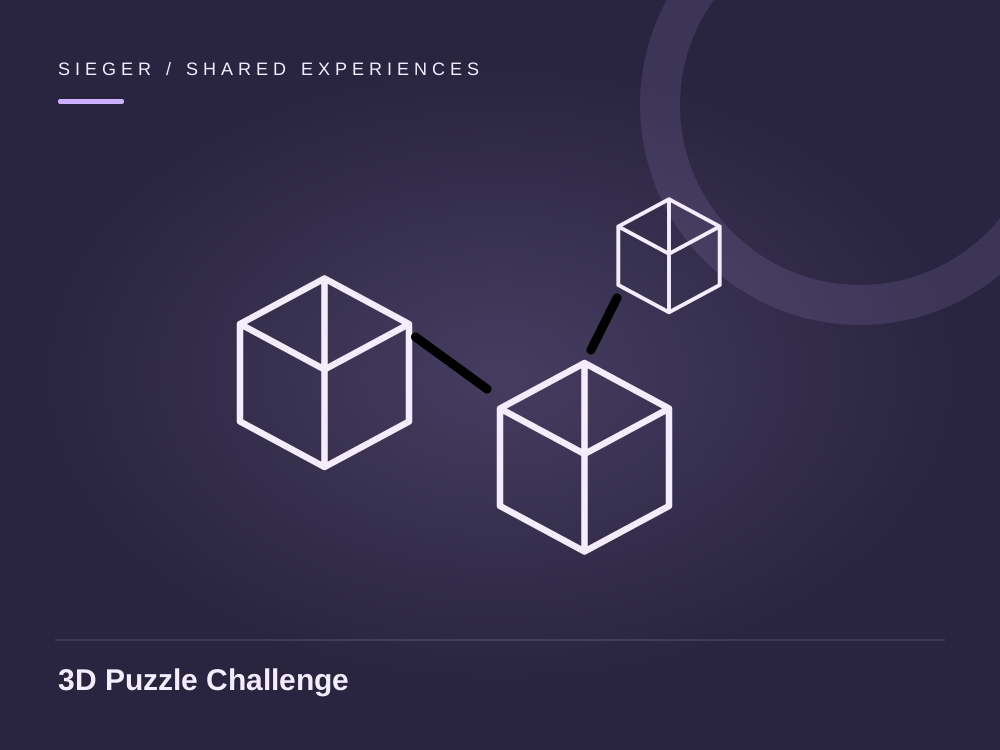
Teams work with a 3D puzzle system in which dimensions, orientation and component relationships determine whether the final assembly works.
Agree the mission rules and success criteria during the briefing, then let your team choose its approach.
A practical progression from the first decision to the final demonstration.
Inspect how the pieces are meant to lock, rotate or support one another.
Agree the measurements that control fit and clearance.
Adjust the component geometry without losing the logic of the puzzle.
Use available parts or a digital fit check; printing depends on the agreed format.
Assemble the puzzle and trace any failure back to a specific dimension or assumption.
Check dimensions and orientation before assuming a part will fit.
Reason about how components relate in three dimensions.
Validate the assembly instead of judging pieces in isolation.
Combine different observations to resolve a shared fit problem.
The team sees how small decisions, shared standards and disciplined execution influence the final outcome.
Plan 3D Puzzle Challenge around your participants, the available time and the decisions you want them to practise.
Group sizes and timings are planning guides. Equipment, technical depth and venue suitability are confirmed in the proposal.
Planning details for 3D Puzzle Challenge. Bring any additional requirements into your conversation with Sieger.
Yes. The activity can focus on analysis and assembly, or include the full design-to-print cycle.
Yes. Number of components, tolerances and hidden constraints can be changed.
Yes. Difficulty, narrative, scoring, team size, duration, venue layout and the workplace behaviour being explored can all be customised.
Yes. The experience can be combined with electronics, drones, robotics, STEM, software, AI and mechanical challenges to create a larger technology challenge journey.
The current planning format is 20–80 participants, organised into teams of 5–6. Confirm the final group size with Sieger so equipment, facilitator coverage and team rotations can be planned.
The indicative activity duration is 75–90 min. Briefing, practice, team presentations and debrief requirements can affect the final agenda; agree the complete session timing during planning.
The proposed kit includes 3D-printed parts, CAD files / design templates, Calipers or measuring tools, Assembly instructions, and Validation kit. Confirm the final equipment list, participant devices and venue requirements with the programme team.
The existing format is designed with engineering teams, quality teams, product teams, cross-functional groups in mind. Share participants’ experience levels so the technical depth and facilitation can be matched to the group.
The facilitator can use the agreed challenge rules, team decisions and observed results to guide the debrief. The discussion connects attention to detail, spatial thinking, quality mindset to situations your team encounters at work.
Send your preferred date, location, participant count and learning objective through the enquiry form or call +91 98400 97567. Sieger can discuss the suitable format, equipment, venue needs and proposal.
A hands-on electronics mission where teams investigate a failed circuit, isolate faults, rebuild the connection and prove the system works again.
Explore the experience ↗
Teams design and activate a working sensor-based alarm system while balancing wiring, logic, testing and team coordination.
Explore the experience ↗
A layered electronic puzzle that combines clues, logic and circuit connections to unlock a final sequence.
Explore the experience ↗Tell us what you have in mind. We will help you explore a programme that fits your people and your occasion.
Still finalising the details? Share what you know.
Every team is different. Share your people, purpose and preferred setting, and we’ll translate your brief into an experience designed to connect, engage and create lasting impact.
Share your brief and preferred contact details.
Choose an experience that connects your people, your purpose and the possibilities of technology.