Share clues early
During finding a hidden route through a labyrinth, record what each person notices before the group settles on a theory.
Paths are made by walking.
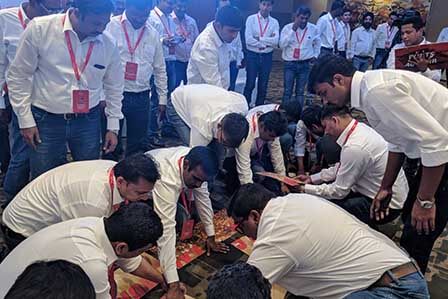
Maze Excape is a team building game that challenges teams solve a problem very collaboratively. The team need to discover a path through a labyrinth, the path is hidden. The labyrinth is represented by a grid on the floor.
Maze Excape is a team building game that challenges teams solve a problem very collaboratively. The team need to discover a path through a labyrinth, the path is hidden. The labyrinth is represented by a grid on the floor.
The path is a series connected squares travelling from one end of the grid to the other. When a team member steps off the path, they will need to start again. To make this suitability challenging, the labyrinth is solved in silence. It requires the team to support each other in order to succeed.
During finding a hidden route through a labyrinth, record what each person notices before the group settles on a theory.
Compare each hunch with the evidence instead of letting the first confident answer dominate.
Keep track of how a new clue changes the team's understanding of the larger problem.
Discuss which question or route is most likely to move Maze Escape forward.
Balance careful reasoning with the time available, and agree when to leave a dead end.
Invite observations from across the group; a small detail may change the whole interpretation.
The session centres on finding a hidden route through a labyrinth. The facilitator briefs the group, guides the activity and helps participants reflect on the choices they made together.
Review the hidden-route challenge and how the group will receive feedback.
Collect observations from attempts so discoveries are available to everyone.
Use the feedback to test the route and avoid repeating unhelpful assumptions.
Discuss how the group retained learning and coordinated its next attempt.
Working through finding a hidden route through a labyrinth shows how a team handles incomplete information. The facilitator can help participants notice whose observations were heard, how the group tested assumptions and when it chose to change direction.
Relate the experience to project decisions: bring evidence together, invite a different interpretation and make the reason for the next choice clear to the people who must act on it.
How did the team record useful information about the maze?
What helped participants avoid repeating an unsuccessful route?
Which discoveries needed to reach the next teammate?
How did the group revise its route as the pattern became clearer?
Reflect on how one person's discovery became a usable guide for others.
Consider what made a failed move informative rather than merely frustrating.
The Maze Escape team-building experience centres on finding a hidden route through a labyrinth. Sieger Group can tailor the facilitation, session flow and venue plan to your group size, event format and objectives.
Ultimately it will create feelings of euphoric success demonstrating what the team can achieve when they work together. The game can be scaled by having multiple teams play simultaneously, creating a competition.
- Collaboration - Cooperation - Non Verbal Communication - Problem Solving - Team Building.
Sieger Group supports organisations with team-building experiences and facilitated programmes.
Answers to common planning questions about the activity, venue and team format.
Maze Excape is a team building game that challenges teams solve a problem very collaboratively. The team need to discover a path through a labyrinth, the path is hidden. The labyrinth is represented by a grid on the floor.
The path is a series connected squares travelling from one end of the grid to the other. When a team member steps off the path, they will need to start again. To make this suitability challenging, the labyrinth is solved in silence. It requires the team to support each other in order to succeed. Participants can share information, listen actively and make their ideas clear during the shared task.
Previous experience requirements depend on the activity format. Share your participants’ experience level and any access needs when enquiring so Sieger Group can discuss a suitable plan.
Yes. Share the outcomes you want to support, such as communication, trust, creative problem-solving or coordination. Sieger Group can discuss how the Maze Escape Team Building Activity format may fit your wider programme.
Venue requirements depend on the activity, equipment and event format. Tell Sieger Group where you plan to host the session so the team can confirm the practical setup.
That depends on the activity and the available setup. Share your preferred indoor or outdoor venue, along with any site constraints, and Sieger Group can advise on suitability.
This activity is designed for groups of 18–100. Share your expected headcount and venue so Sieger Group can confirm a suitable arrangement.
Allow 45–60 minutes for the activity session. Sieger Group can confirm the timing against your event schedule and agreed format.
Please share your preferred date, location or venue, expected group size, audience, event objectives and any practical requirements. This helps Sieger Group respond with relevant planning details.
Use the enquiry section on this page or the shared Get in Touch option. Tell us about your team, location, preferred date and goals; Sieger Group will follow up to discuss the activity and next steps.
Tell us what you want your team to practise through Maze Escape Team Building Activity. Sieger Group can help plan a facilitated session around your group, venue and event goals.
Discuss a suitable session format, activity flow and level of challenge for your team.
Still finalising plans? Share what you know and we can start there.
Leave your details and a little about the session you have in mind.
Share your event brief for Maze Escape Team Building Activity with Sieger Group and shape a session around your people and objectives.